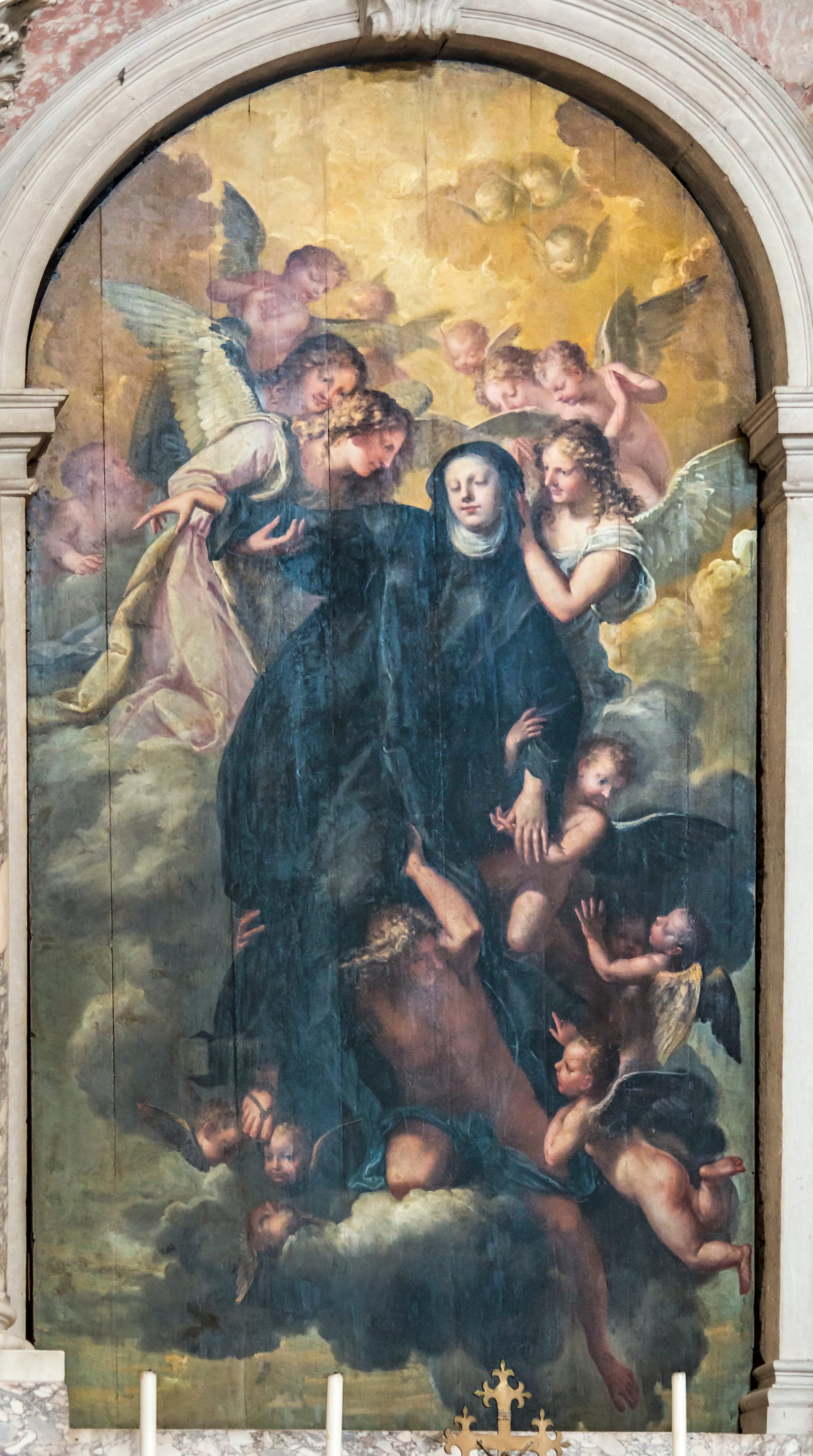
Of Gertrude's parents and birthplace nothing is known — only the day she was born, January 6, 1256, the feast of the Epiphany. In 1261, at five, she was brought to the monastery of Helfta in Saxony, a house of nuns under the Rule of St. Benedict then governed by the Abbess Gertrude of Hackeborn, and she was taught by the abbess's sister, St. Mechtilde of Hackeborn. She learned everything the schools of her day could teach, the trivium and the quadrivium, and loved literature, music, song and the painting of miniatures (Benedict XVI, General Audience, 6 October 2010). She was a nun all her life, not an abbess; the crozier some old pictures give her belongs to her abbess of the same name.
In Advent 1280, Benedict XVI writes, 'she began to feel disgusted with all this and realized the vanity of it all.' On January 27, 1281, at the hour of Compline, she bowed to an older nun in the dormitory, and on raising her head, she wrote, she saw Christ 'under the form of a youth of sixteen years', who said to her: 'Thy salvation is at hand; why art thou consumed with grief?' Then He placed His right hand in hers, 'as if to ratify Thy promise', as she wrote to Him. She was twenty-five. Her biographer put the change in one line: from a grammarian she became a theologian.
The twenty years that followed are recorded in the Herald of Divine Love (Legatus divinae pietatis), in five books. Only Book II is in her own hand; the rest was compiled by her sisters at Helfta from what she told them. Her Spiritual Exercises, seven in number, are her own. In the sixteenth century the Carthusian Lanspergius and Louis de Blois spread her writings across Europe.
On the feast of St. John, the Herald records, she rested in vision at the wound in Christ's side and felt the beating of His Heart, and asked the Evangelist, who had lain on that breast at the Last Supper, why he had never written of it. He answered that he had 'deferred speaking of these Divine pulsations until later ages, that the world might be aroused from its torpor, and animated, when it had grown cold, by hearing of these things.' Four centuries later came St. Margaret Mary Alacoque and the feast of the Sacred Heart.
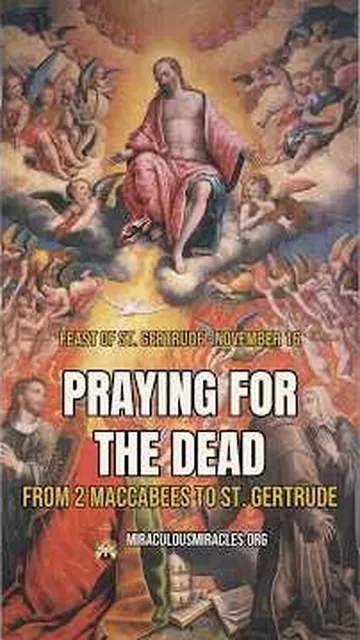
Her charity, wrote the Catholic Encyclopedia, 'was manifested in tender sympathy towards the souls in purgatory', and Book V of the Herald is largely about the dead. She prays at the deathbeds of her sisters, offers the Host for them, and gives away all her merits for the departed. When she asked Christ to relieve a soul for her sake, the Herald records His answer: 'Not only would I deliver this soul, but thousands of souls, for your love!' It is the practice Scripture already commends: 'It is therefore a holy and wholesome thought to pray for the dead, that they may be loosed from sins' (2 Maccabees 12:46).
A prayer for the holy souls, 'Eternal Father, I offer Thee the Most Precious Blood of Thy Divine Son, Jesus, in union with the Masses said throughout the world today…', has long been prayed under her name, often with a promise that each recitation frees a thousand souls. The prayer does not appear in the Herald or the Spiritual Exercises, and the Church has never ruled on the promise.
Often ill in her last years, she died at Helfta on November 17, 1301 or 1302, at about forty-six. Where she was buried is unknown; 'there is, at least, no record of their translation' (Catholic Encyclopedia, of her and St. Mechtilde). She was never formally canonized: her name was entered in the Roman Martyrology in 1677, her feast was extended to the whole Church, and at the petition of the King of Spain she was declared patroness of the West Indies; in Peru her feast was kept 'with great pomp' (Catholic Encyclopedia, 1909). Her feast is now November 16. Benedict XVI called her 'the only German woman to be called "Great"', because of her cultural and evangelical stature.