
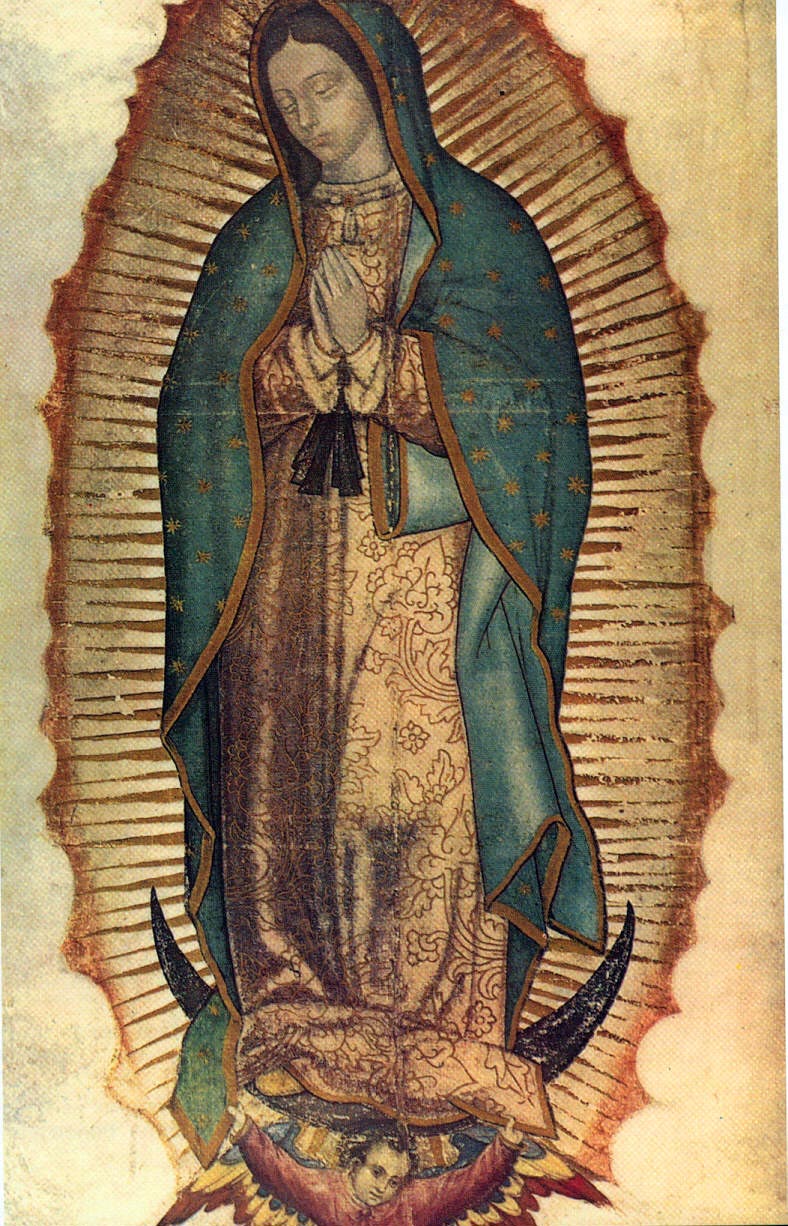
The tilma is the cloak St. Juan Diego was wearing on December 12, 1531, when he opened it before Bishop Juan de Zumárraga. The roses he had gathered fell to the floor, and on the cloth was the image of the Virgin: a young woman with her head bowed and her hands joined in prayer, a mantle of stars over a rose-coloured robe, standing on a crescent moon borne up by an angel, with the rays of the sun behind her. It hangs today behind glass above the high altar of the Basilica of Our Lady of Guadalupe in Mexico City, where some twenty million pilgrims come each year.
It is about 1.7 metres tall and a little over a metre wide, two lengths of cloth joined by a seam. The photographer Alfonso Marcué González measured it at 168 by 105 centimetres in 1946; the conservator José Sol Rosales at 172.5 by 109 in 1982, counting its folded edges. Painters and physicians examined it as early as 1666, and many have studied it since. What each reported is set out below, with who said it and when. The Church's judgement concerns the apparition and the devotion; it has never ruled on these studies.
The figures reported in her eyes
The eyes of the image are very small: by the measurement of José Aste Tönsmann, the corneas are about eight and seven millimetres across. In 1929 Alfonso Marcué González photographed the image closely, and devotional histories say he saw in one of his photographs what looked like a bearded man in the right eye. On May 29, 1951, the draughtsman José Carlos Salinas Chávez, studying a photograph of the face through a magnifying glass, saw the head of a bearded man in the right eye, and then in the left. He later set out the discovery, with Manuel de la Mora, in Descubrimiento de un busto humano en los ojos de la Virgen de Guadalupe (1980).
In 1956 eye doctors took up the question. The ophthalmologist Javier Torroella Bueno reported on the eyes that year, and Rafael Torija Lavoignet examined the original image itself five times between July 1956 and May 1958, using an ophthalmoscope as his light and his lens. His report, as it has been reproduced, describes the human bust in both eyes and, in the right eye, two further points of light, which with the bust he identified as the three Purkinje–Sanson images: the reflections a living eye makes of whatever is in front of it, one from the surface of the cornea and two from the lens, the last of them upside down.
From 1979 José Aste Tönsmann, a Peruvian civil engineer with a doctorate in systems engineering from Cornell University, studied the eyes by digital image processing, enlarging them some 2,500 times. He reported thirteen human figures in the two corneas, most of them in both eyes, in different sizes. He took one group to be the scene in the bishop's house: a seated Indian, an old man he identified as Bishop Zumárraga, a young man he identified as the interpreter Juan González, Juan Diego himself, a Black woman, and a bearded man of European features. At the centre of the eyes, on a smaller scale, he found a second group, a family: a young mother with a baby, a man in a hat, children, and an older couple standing behind. He spoke of it as a message about the family. He died on November 25, 2024, at ninety-three.
Others read the same photographs more cautiously. The Catholic historian Daniel Castellano, in his study of the image, finds the bearded man's face 'clearly recognizable' in the right eye and less clear in the left, and accepts that the right eye shows reflections where Purkinje–Sanson images would fall, though he notes that the second and third 'are not obvious human forms' and that 'we are dealing with a scale that approaches the resolution of individual threads'. The claims of as many as thirteen figures, he judges, 'are not substantiated by expert analyses'. The Church has never ruled on the figures in the eyes.
What the cloth is made of
The account calls it his tilma, and tradition has long called it an ayate, a cloth woven of maguey (agave) fibre. In 1946 the biologist Isaac Ochoterena, of the National University of Mexico, examined a few milligrams of its threads; his signed letter, kept in the basilica library, concluded that the plant was an agave of undetermined species. Castellano calls it the only analysis yet made that was competent to settle the question, while noting that the letter does not record where the sample came from.
In 1982 José Sol Rosales examined the cloth under a microscope through one night. He was 'practically certain' it was not of the hard fibres of the ixtle or henequén kind, nor of cotton, and thought it linen with some hemp, though he did not claim to have identified it for certain. He described the weave as plain and handspun, with ten to thirteen threads to the centimetre.
How it has lasted nearly five hundred years
For more than a century the image hung with no glass over it, in the smoke and heat of the votive candles, and the faithful touched it and kissed it. A glass case was fitted in the seventeenth century, and even that was not airtight. It hung in the old basilica, in the damp and salty air of Tepeyac, until 1974, and has been enthroned in the new basilica since 1976.
The physicist Adolfo Orozco, speaking at the International Marian Congress on Our Lady of Guadalupe in 2009, said that its conservation 'is completely beyond any scientific explanation'. Cloths like it, placed in the same air around the basilica, he said, 'have lasted no more than ten years', and he told of a copy painted in 1789 on a very similar cloth, kept behind glass from the first, which was discarded eight years later because its colours were fading and its threads breaking. The original, he said, was exposed 'for approximately 116 years without any kind of protection'.
The story is also told that in the late eighteenth century, workmen cleaning the frame spilled nitric acid on the right side of the cloth; Orozco dated it to 1785. 'The acid has not destroyed the fabric of the cloth,' he said, 'indeed it has not even destroyed the colored parts of the image.' In 1946 Joaquín Flores saw a stain on the right side where the acid was said to have fallen, and the 1982 examination recorded a mark in the upper right.
On the night of May 7, 1979, the American biophysicist Philip Serna Callahan photographed the image under infrared light. He reported that the face, the hands, the mantle and the robe show no underdrawing, no sizing of the cloth beneath the paint and no protective varnish, and that the angel shows brush strokes 'which are not evident in the face, hands, mantle or robe'. The moon and the angel, the sunburst and the gold trim, and the stars he judged to be later additions; beneath the angel and the moon he found the cloth had been sized, and the gold of the rays he found in very bad condition. 'Oil on unsized cloth and unprotected by varnish,' he wrote, 'would have rotted the tilma within fifty years' (The Tilma under Infra-Red Radiation, 1981).
That the image has been retouched has never been hidden. Marcué González called the retouches, in 1946, 'light retouches, made surely with a sense of mistaken piety'; Callahan found the hands the most altered part; and Sol Rosales, who in Castellano's words was 'himself no believer in the Guadalupan miracle', found the outline of the face and the hands lightly repainted. He also recorded that before his own work there was no varnish on the image and no visible brush stroke. In remounting it he applied a varnish, and Castellano notes that this makes its condition since 1982 impossible to judge by the same measure.
In 1921 a bomb hidden in flowers exploded at the foot of the altar beneath it, and neither the image, nor its frame, nor the glass over it was damaged. That story has its own page: The Tilma of Guadalupe Survives the 1921 Bombing.
The story of the colours
A story often repeated says that in 1936 two threads of the tilma, one red and one yellow, were sent to the German chemist Richard Kuhn, who won the Nobel Prize in Chemistry for 1938, and that the answer came back that the colours matched no known natural pigment, vegetable, animal or mineral. The story comes from Ernesto Sodi Pallares, in a report he wrote with Roberto Palacios Bermúdez in 1976. No paper by Kuhn on it is known, and decades later his son said he could find no record of such a study (Jody Brant Smith, The Image of Guadalupe, 1994).