
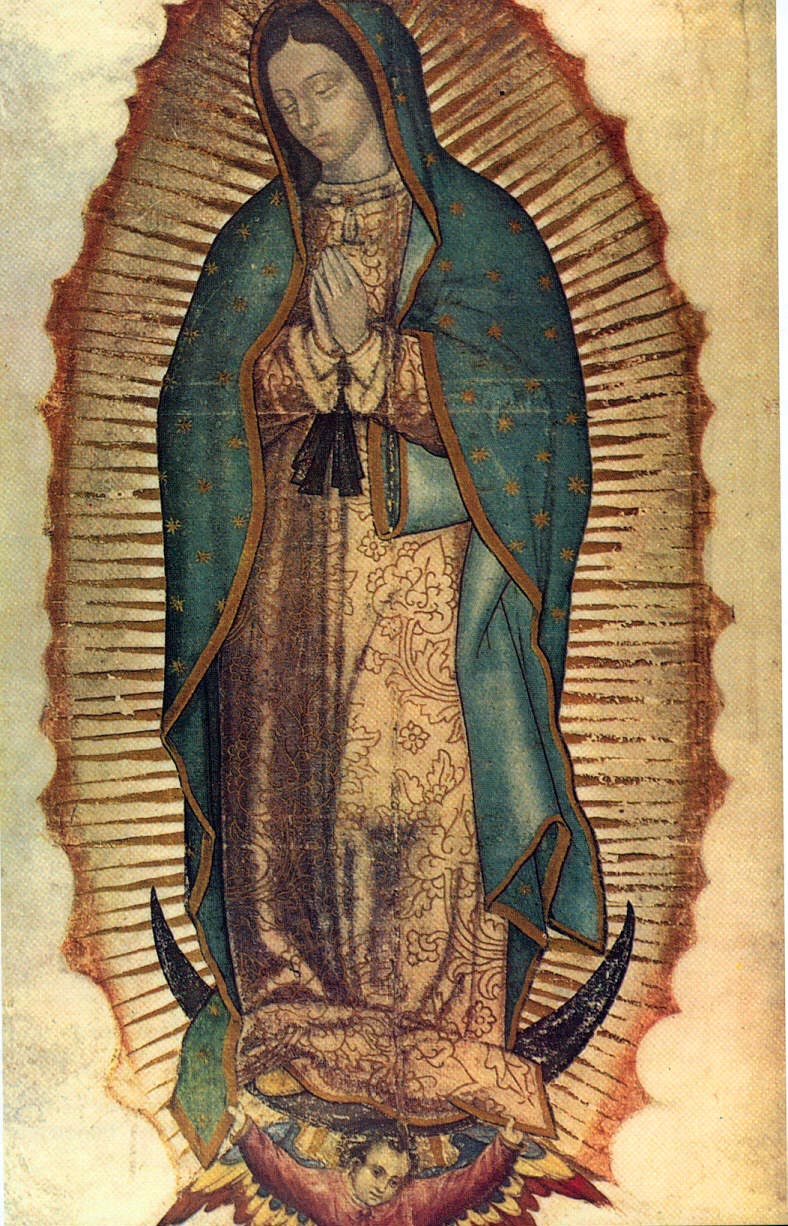
In December 1531, an Indigenous Mexican man named Juan Diego Cuauhtlatoatzin — a recent convert from the Chichimeca people — was crossing Tepeyac Hill on his way to Mass when he heard music and a voice calling him. There he encountered a luminous woman who identified herself as 'the perfect ever-Virgin Holy Mary, Mother of the true God for whom we live,' and asked that a church be built on the site so she might show her love to the people of Mexico.
Juan Diego brought the request to Bishop Juan de Zumárraga, who asked for a sign. After several apparitions, Mary instructed Juan Diego to gather flowers blooming out of season — Castilian roses — on the wintry hilltop. He carried them in his tilma (a coarse cloak woven from cactus fiber) and presented them to the bishop. When he opened the tilma, the roses tumbled out — and there, on the cloak, was the image of the Virgin Mary as she had appeared on Tepeyac.
That tilma still hangs in her basilica, nearly five hundred years later. What it is made of, how it has lasted, and the figures reported in the eyes of the image have been studied since the seventeenth century, by painters, physicians, chemists, eye doctors and engineers; the Church has never ruled on those studies. Their history, with who reported what and when, is told on the page given to the image itself: The Image on the Tilma of Guadalupe.
Devotion to Our Lady of Guadalupe is credited with the conversion of millions of Indigenous Americans in the years following. The Basilica of Guadalupe in Mexico City receives approximately 20 million pilgrims each year, making it the most-visited Marian shrine in the world.