
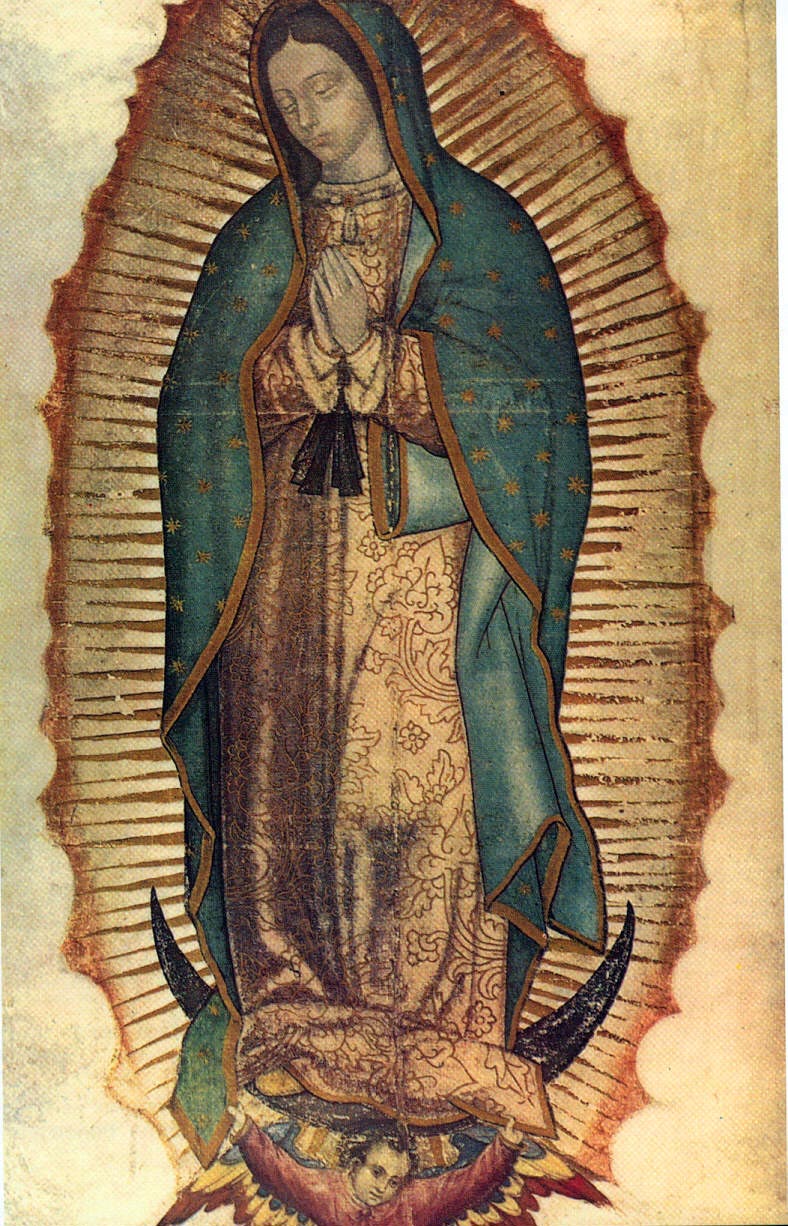
On the morning of November 14, 1921, under the government of President Álvaro Obregón, in the years of anti-clerical measures that led to the Cristero War, a man came up to the high altar of the old Basilica of Guadalupe at Tepeyac and set a flower arrangement at its foot. Mass had just ended. Hidden among the flowers was a dynamite bomb.
It went off at about half past ten. The blast broke the marble steps of the altar and threw down the brass candlesticks; at the centenary, a canon of the basilica said the altar was left destroyed and all its marble broken. The crucifix on the altar, of bronze and iron and weighing thirty-four kilograms, took the force of the explosion, fell, and was left twisted. The image above it was untouched: neither its frame nor the glass that protected it was damaged.
A man named Luciano Pérez Carpio, described in the press as a railway worker, was seized at the scene, and the crowd would have lynched him had President Obregón not telephoned to order that he be protected. He was later released. Accounts of the time laid the blame on the president; at the centenary, the canon of the basilica said it was never confirmed that Pérez was the one who set the bomb.
The bent crucifix is kept in a glass case in the present basilica, to the right of the central door, beside the account of the attack. It is called the Santo Cristo del Atentado, the Holy Christ of the Attack, and the words with it read: 'The Son protected the mother.' 'Christ took the whole blast,' Canon Luis Felipe García Álvarez said at the centenary in 2021, 'defended our mother, and gave her back to us.'